
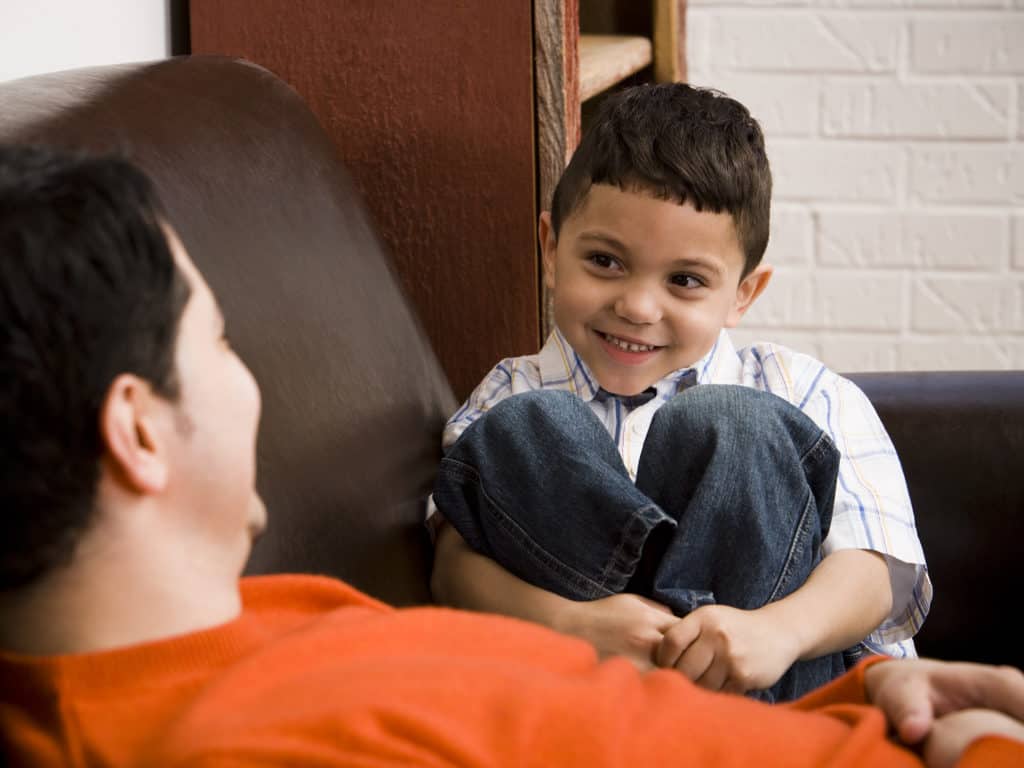
If you are like many adoptive parents it can come as a big surprise when your elementary school-aged child, who has always “known” that they were adopted, begins to ask questions you thought were answered years ago. In many ways you’re right—you have probably told your child their story many times and answered their questions. But something transformative happens between the ages of six and eight that shakes everything up. As your child moves into middle childhood, they experience remarkable cognitive changes, from newly found reasoning and problem-solving skills to being able to take another person’s perspective for the first time.
By this age, most children are not only able to notice what makes them similar to and different from others, but they are able to arrange their thoughts into questions about skin color, family composition, and reproduction—which allows them to think about their adoption in a whole new way. It’s an exciting time, but also comes with some sadness and confusion as many adopted children are able to understand for the first time that relinquishment led to their being adopted. This is a significant shift for children and their parents and many of our coaching clients reach out to us at this time for support and to get practical tools and tips to help navigate these conversations.
Here are some of the techniques we use when coaching parents thru this stage of adoption development.
-
Go Slowly and Listen Carefully. It may sound counterintuitive but try your best not to rush in to answer your child’s questions or fix what might seem like a problem. Instead, listen carefully and ask your child simple questions to help them express what’s on their mind. This could sound like: “You mentioned that you wish you grew in my belly; what do you think that would have been like?” With a focus on listening, you will learn to see the world from your child’s perspective and be better prepared to respond to your child’s unique needs. We often use role playing in coaching sessions to help parents develop and practice this skill.
-
Keep Playing. If you’re getting tripped up over finding just the right words you are in luck because helping a young child make sense of adoption also happens through play. Play themes of caretaking, nurturing, separation and reconnection, belonging, being lost and found are common among all children and can have an added layer for adoptees. Your child may incorporate elements from movies or stories that worry or delight them, and it is through their play that they express their emotional experience symbolically. We often inform parents that it’s not necessary to correct a child’s play or to interpret the story line, just acknowledge the story line. You can simply enjoy the intimate experience of being included in their imagination and take note of the concerns or themes that your child is working through.
-
It’s Not about You. At this age, children are able to ask very direct questions about their biological family, and some parents feel hurt by their little one’s curiosity about their past. One thing that may help is to keep in mind that your child’s interest in their birth family is not a rejection of you. It’s hard, but crucial, that parents do not take this personally. Even at a young age, children are experts at picking up on this kind of defensiveness, and if your child feels that they are upsetting you, they may retreat from future discussions. Coaching sessions can help parents recognize how their own grief and fear may be getting in the way of responding well to their child’s developmentally appropriate questions.
-
Use Props and Resources: Using props to help move conversations forward is especially grounding when emotions run high and we can literally “hold on” to something to help us stay on topic. For example, picture books help to identify feelings, reflect diversity in families, and show images from birth places. Children’s literature is now bursting with adoption-themed stories, including chapter books. There are non-competitive games to encourage communication and build attachment as well as videos created to help both children and adults understand adoptive family life. This is also an ideal time to attend a Lifebook workshop to create or re-create a Lifebook with your child that will help facilitate conversations about their adoption story. Consider your coach as a personal guide to help you identify the right tools and how to use them to keep these conversations going.
-
Build Your Community: The usefulness of making connections with other adults and children who truly understand what you and your child are experiencing can’t be overestimated. People who are not personally connected to adoption, although loving and well-meaning, are simply unable to help in the way that other triad members can. I often encourage parents that when the time is right, becoming part of an adoption community can truly be life changing. Here at Spence-Chapin we believe that adoption is a lifelong journey and help parents build their community early with our Bagels and Blox Sunday meet ups. This is where young children and their parents can meet to play and socialize. We also have Play Café which gives adopted children 6-8 a place to explore their feelings through arts and crafts. Whether through 教練, a playgroup or support group, 導師計劃, social event, or on-line forums. There is a way to connect that can be the right fit for you.
聽吓呢個由 Spence-Chapin 嘅收養前後服務部執行副總裁 Mark Lacava , LCSW-R 嘅播客,討論小朋友喺唔同發育階段會問嘅常見問題,同埋點樣答呢啲問題。.
Any parent who has ever wondered how much their child needs to know about adoption and how to share it with them can benefit from a 教練班. Spence-Chapin’s 教練 同 counseling services can support you to gain clarity and receive guidance no matter your child’s age. Contact us at 646-539-2167 or [email protected] 安排初步諮詢。.
